
What every parents should know before it’s too late
As a parent, you must have received a lot of responses when you expressed concerns about your child’s delayed speech. Even though some of the responses are shared with love and good intentions, these reassurances can unfortunately lead to something dangerous in the form of delay in seeking the right help.
Some of the common suggestions include: “He will talk when he’s ready.”
“Boys are naturally slower than girls.”
“Even your aunt didn’t speak until she was 5 and now she’s a doctor.”
Let’s get one thing clear, speech delay is not always “just a phase.”
In some cases, it’s a sign of a bigger developmental concern, such as hearing loss, Autism Spectrum Disorder (ASD), a language disorder, or other underlying challenges that require early intervention/support.
So how do you know if your child is just taking their time or if they need professional attention?
First, what’s normal in speech development?

Children vary in their development of language skills. However, they follow a natural progression for mastering language skills. So a few months of variation might not be cause for concern. However, if your child isn’t meeting multiple milestones, or their development seems to be stuck at a particular level for months or reversing, that’s a red flag.
Most children’s first signs of communication happen when they learn that a cry will bring food, comfort or attention. According to Standford Medicine Children’s Health, developmental milestones related to speech and language include;
| Age | Speech and Language milestones |
| Birth to 5 months | Coos,Vocalizes pleasure and displeasure sounds through laughs, cries and gigglesMake noises when spoken to |
| 6 to 11 months | Understands “no-no”Babbles and says “ba-ba-ba-ba”Says “ma-ma” or “da-da” without meaningTries to communicate by actions or gesturesTries to repeat your soundsSays the first word |
| 12 to 17 months | Answers simple questions nonverballySays 2 to 3 words to label a noun (pronunciation may not be clear)Tries to imitate simple wordsvocabulary of 4 to 6 words |
| 18 o 23 months | Vocabulary of 50 words, pronunciation is often unclearAsks for common foods by nameMakes animal sounds, such as “moo”Starting to combine words, such as “more milk”Begins to use pronouns, such as “mine”Uses 2-word phrases |
| 2 to 3 years | Knows some spatial concepts, such as “in” or “on”Knows pronouns, such as “you,” “me” or “her”Knows descriptive words, such as “big” or “happy”Uses 3-word sentencesSpeech is becoming more accurate, but may still leave off ending sounds. Strangers may not be able to understand much of what is said.Answers simple questionsBegins to use more pronouns, such as “you” or “I”Uses question inflexion to ask for something, such as “my ball?”Begins to use plurals, such as “shoes” or “socks” and regular past tense verbs, such as “jumped” |
| 3 to 4 years | Groups objects, such as food or clothesIdentifies colorsUses most speech sounds, but may distort some of the more difficult sounds, such as l, r, s, sh, ch, y, v, z, and th. These sounds may not be fully mastered until age 7 or 8.Uses consonants in the beginning, middle, and end of words. Some of the more difficult consonants may be distorted but attempts to say themStrangers are able to understand much of what is saidAble to describe the use of objects, such as “fork” or “car”Has fun with language; enjoys poems and recognizes language absurdities, such as, “Is that an elephant on your head?”Expresses ideas and feelings rather than just talking about the world around him or herUses verbs that end in “ing,” such as “walking” or “talking”Answers simple questions, such as “What do you do when you are hungry?”Repeats sentences |
| 4 to 5 years | Understands spatial concepts, such as “behind” or “next to”Understands complex questionsSpeech is understandable, but makes mistakes pronouncing long, difficult, or complex words, such as “hippopotamus”Uses some irregular past tense verbs, such as “ran” or “fell”Describes how to do things, such as painting a pictureLists items that belong in a category, such as animals or vehiclesAnswers “why” questions |
Warning Signs That It’s Not Just Late Talking
Look out for these additional signs that might suggest a bigger developmental concern:
1. No pointing or gesturing by 12-15 months
Children usually use gestures like pointing, waving, or nodding as early ways to communicate.
2. Doesn’t respond to their name
This can be mistaken for stubbornness or even hearing problems, but it’s also an early sign of autism.
3. Limited eye contact
If your child avoids eye contact, it might be more than just shyness.
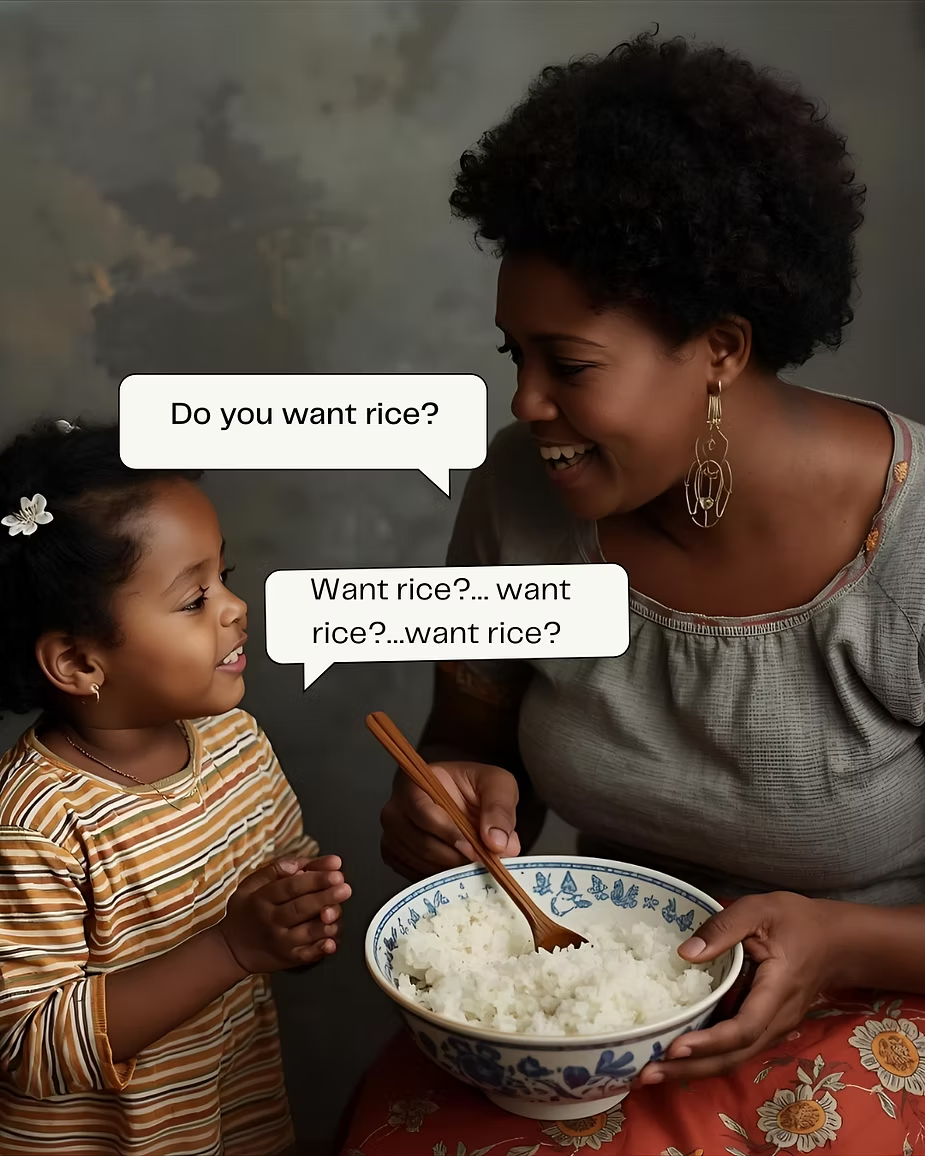
4. Repeats words over and over (echolalia)
Repetition of phrases or words with no clear purpose can be linked to communication difficulties.
5. Lack of interest in playing with others
Children naturally enjoy watching or copying others. A lack of interest may be a social communication concern.
6. Regressing in skills
If a child once says a few words but then stops, this may indicate a developmental regression which is often seen in autism.
In Our Nigerian Homes… Mrs. A’s Story
Her son, T, was 2½ and still not speaking clearly. He mostly cried or dragged his parent’s hand whenever he needed something. Her mother-in-law said, “Na so your husband be, e no talk quick.” But Mrs. A knew something felt off.
After attending a screening at BestStarts screening at Nuture CDC, she realized T, also didn’t play with other children and rarely looked people in the eyes. She booked further assessment. T was diagnosed with autism and thanks to early intervention, he now communicates using picture cards and is building vocabulary through therapy.

Why Early Intervention Matters
The brain is most flexible and responsive to change before the age of 6. That’s why early intervention leads to better outcomes.
The longer you wait, the harder it becomes to teach certain skills especially communication, attention, and social skills.
“But what if I’m wrong? What if he starts talking next month?”
Then that’s great! But wouldn’t you rather rule out a problem early than miss the chance to support your child when it counts most?
To get a proper developmental screening by professionals. This is not the same as going to a general hospital or “talking to aunty nurse at church.” Reach out to us at Nuture CDC, at a discounted screening fee.
What If I’m Scared?
That’s okay. Most parents are!
You may fear:
- Being blamed by others
- The word “autism”
- Spending money on therapy
- What people will say
However, here is something no one tells you enough,
“You are your child’s greatest chance at progress”.
So choosing to act doesn’t mean something is “wrong” with your child. It means you are giving them the support they need to blossom in their way.

We can Take the First Step Together.
If you’re worried, even just a little about your child’s speech or development, don’t wait. Booking a developmental screening early helps change everything. Click here to get started.
Final Note
Dear parent, you are not imagining things.
You’re not being “too worried” or “too fast.”
The real question is not, “Will he talk?”
It is “Will I take action early enough to give him the best chance to thrive?”
Hence, the answer lies in your hands today.
References
Stanford Children’s Health. Age-appropriate speech and language milestones. Retrieved June 16, 2025, from https://www.stanfordchildrens.org/en/topic/default?id=age-appropriate-speech-and-language-milestones-90‑P02170